


Precision Meets Performance: How JULABO Liquid Temperature Control Enhances Life Sciences Research
I. Introduction
The Crucial Role of Temperature Control in Life Sciences
Think of temperature control in the life sciences as the unsung hero working quietly behind the scenes. Whether it’s preserving delicate cell cultures, running precise chemical reactions, or storing life-saving vaccines, the right temperature isn’t just a “nice-to-have”—it’s essential.
Why? Because biology is temperature-sensitive to its core. Proteins can unfold, cells can die, and chemical reactions can go haywire with just a few degrees of variation. In many lab and clinical settings, even a minor fluctuation can mean the difference between success and starting over.
Take drug development, for example. During stability testing, temperature needs to be tightly regulated to simulate how a compound will behave over time. Or consider cryopreservation: freezing cells or tissues at ultra-low temperatures to pause biological time. Without precise control, the very things we’re trying to protect can be damaged beyond use.
Even on the logistics side—such as cold-chain shipping for vaccines—consistent temperature is key. A break in the cold chain can compromise efficacy and safety, and often there’s no visible sign until it’s too late.
In short, temperature control isn’t just a technical detail; it’s foundational. It safeguards integrity, enables reproducibility, and ultimately, protects lives.
Precision in Temperature: The Basis of Accuracy, Reproducibility, and Safety in Life Science Labs
As stated above, in the life sciences, precision isn’t a luxury but a necessity. When it comes to temperature, even the smallest variation can have immense negative effects. That’s why precise temperature management plays such a critical role in lab environments. It directly supports the three pillars every scientist relies on—accuracy, reproducibility, and safety.
First, accuracy. Many biological and chemical reactions are temperature-dependent. If a PCR cycle is even a few degrees off, it can result in flawed amplification, leading to false negative or positive results with significant implications in diagnostics or forensics. If an incubator drifts too warm, cells might behave unpredictably or die off.
Next is reproducibility, the core of credible science. Repeating an experiment next week or even in another lab should yield the same result. That can only happen when environmental factors, especially temperature, are stable. Without that consistency, it’s impossible to tell if differences in data are real or just the result of uncontrolled parameters.
And then there’s safety. In a lab handling pathogens, volatile chemicals, or cryogenic materials, temperature acts as a safety guardrail. Overheating or accidental thawing can pose serious risks to samples and people. Proper temperature management helps keep the lab productive and protected.
In summary, precise temperature control allows life science labs to conduct high-quality science while maintaining safety.
JULABO USA: Leading the Way in High-Performance Temperature Control
When it comes to liquid temperature control, JULABO isn’t just a participant; it’s a pioneer, following in the footsteps of its founder’s father, who invented the first glass contact thermometer in 1927. With decades of experience, JULABO has established itself as a trusted leader in high-performance solutions that power the life sciences, pharmaceuticals, chemistry, and numerous other fields.
From precise heating and cooling circulators to reliable chillers and temperature calibration tools, JULABO’s technology is designed to give researchers confidence in their temperature management.
But what really sets JULABO apart isn’t just the hardware—it’s the people. With a strong focus on service, support, and collaboration, JULABO USA partners with scientists and engineers to solve real-world problems, not just ship boxes. Our solutions are tailored, tested, and trusted.
In short, JULABO USA does more than control temperature. It empowers discovery, ensures quality, and helps push the boundaries of what science can achieve.
II. Why Temperature Control Matters in Life Sciences

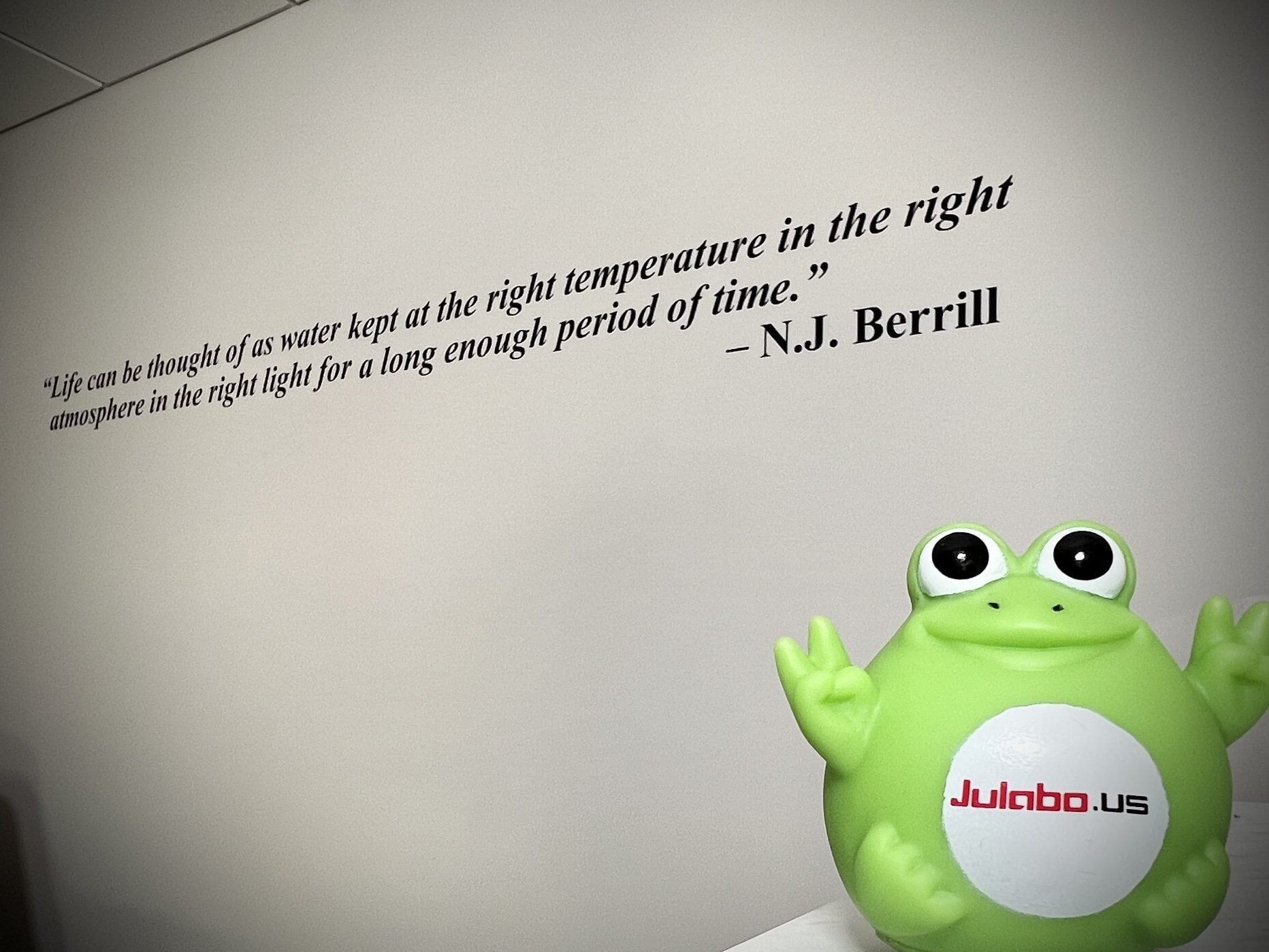
This goes back to the motto we reprinted on the wall of our facility, a quote by marine biologist N.J. Berrill: “Life can be thought of as water kept at the right temperature, in the right atmosphere, in the right light, for a long enough time.”
Taking this to heart means that if life needs the right temperature—as we all know from our own experience—then life sciences need it to the same degree (pun intended).
Let us dive into some major temperature-sensitive applications.
Bioreactor temperature control
Precise temperature control is crucial in bioreactor operations for pharmaceutical, biotech, and R&D applications because it directly influences biological activity, product quality, and process reliability. Deviations can compromise cellular metabolism, reproducibility, and regulatory compliance.
Organisms such as eukaryotic and prokaryotic cells require species-specific temperature ranges for optimal growth and function. Even the smallest deviations can disrupt metabolic pathways, reducing yield and altering product characteristics. They may also cause protein denaturation or cell lysis, making products ineffective. Consistent temperature profiles ensure experimental results are repeatable, which is critical for validating R&D findings.
Other factors are product quality and regulatory compliance. Biopharmaceuticals (e.g., vaccines, monoclonal antibodies), for example, degrade when exposed to suboptimal temperatures, leading to a loss of potency or safety failures. Therefore, regulatory bodies (FDA, WHO) mandate strict temperature control during production and storage.
Moreover, precise control minimizes energy loss from overheating or overcooling, lowering operational costs and reducing the environmental footprint.

Chromatography and spectroscopy
In chromatography of various types, temperature control is also crucial. This can be achieved by tempering the solvents and eluents in JULABO water baths, such as the PURA models, or by controlling the column temperature with incubators or a circulator. Various spectrophotometers also need cooling and heating, which can be effectively provided by JULABO thermostats. Details and product recommendations for chromatography and spectroscopy can be found in the blog post about temperature control in analytical chemistry here.
Protein crystallization
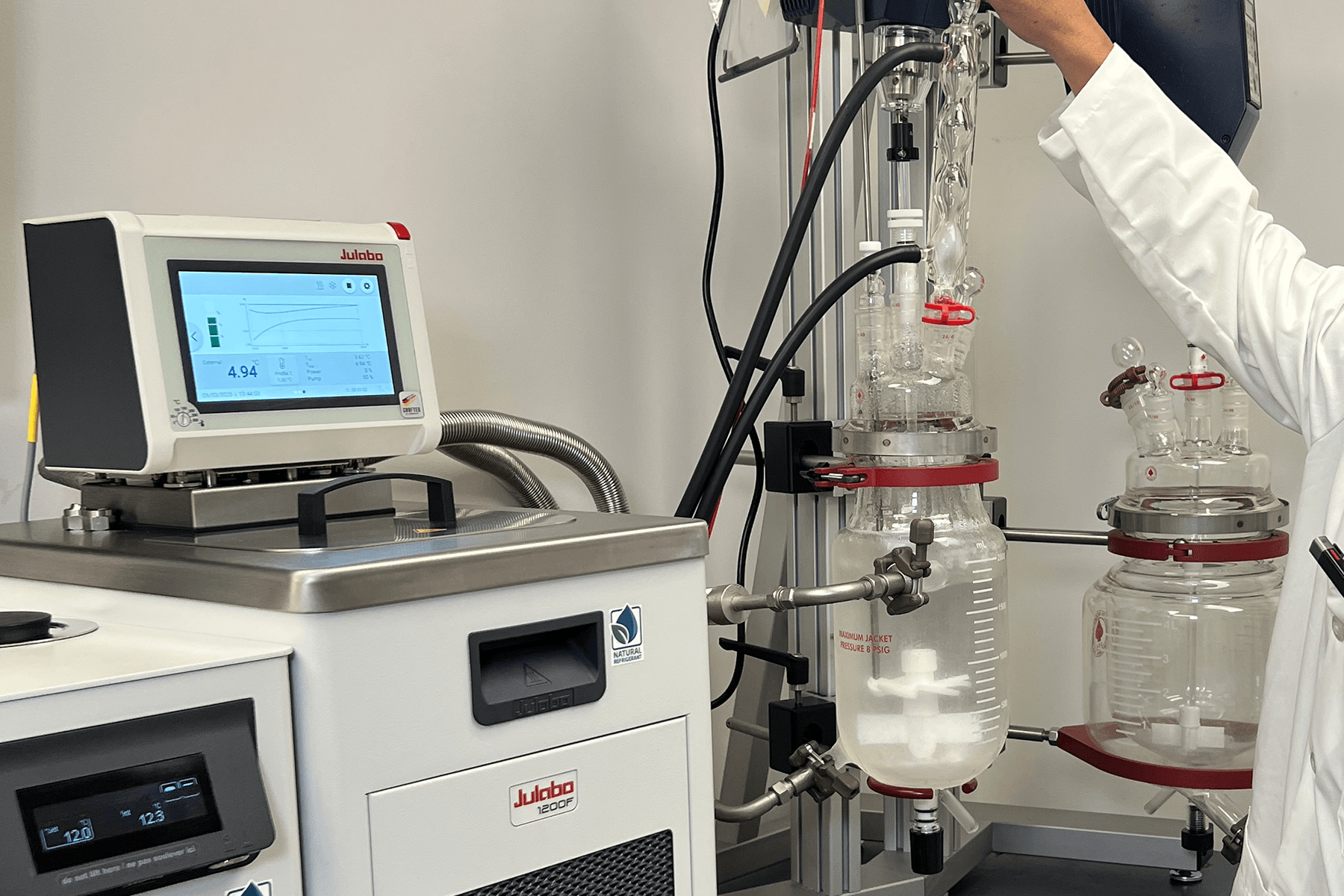
Protein crystallization usually occurs between 20 °C and 0 °C, and sometimes down to –40 °C. The cooling gradient must be very slow—typically 0.1–1 °C per hour—to ensure proper crystal formation and purity before the crystals are later used in X-ray studies. To achieve this, incubators or Peltier elements in microfluidic cells are used, while larger setups use jacketed reactors with circulators such as the JULABO DYNEO or MAGIO series (see image below).
III. JULABO Equipment Tailored for Life Sciences Labs
Refrigerated and Heating Circulators (e.g., JULABO CORIO, DYNEO, and MAGIO series)
JULABO’s CORIO, DYNEO and MAGIO refrigerated and heating circulators are purpose-built to support the demands of modern life science laboratories. Engineered for versatility, these systems excel in applications ranging from jacketed glass reactors and enzyme kinetics to material testing, ensuring precise thermal control across many different workflows.
The DYNEO DD1200F and DD-1200FW benchtop models stand out with a broad operational temperature span of -50 °C to +200 °C, accommodating extreme cooling and high-temperature heating requirements. Users can select between 1 kW or 2 kW of heating power, while the robust cooling system delivers 1.24 kW at 20 °C for rapid temperature shifts. An adjustable pump provides flow rates from 8 to 27 L/min and pressures from 1.5 to 10.2 PSI, optimizing performance for experimental needs.
Connectivity is streamlined and adaptable, with a standard USB port and options for analog or RS232 interfaces, making integration with laboratory data systems easy. The units operate with minimal noise and utilize R1270, a natural refrigerant, supporting environmentally responsible lab practices.
Altogether, JULABO’s CORIO, DYNEO and MAGIO circulators deliver the reliability, flexibility, and sustainability essential for advancing life science research and production.
Recirculating Chillers (e.g., JULABO FL Series)
JULABO FL Series Recirculating Chillers are designed for dependable, everyday laboratory cooling. These units are ideal for applications with HPLC systems, rotary evaporators, and vacuum pumps. With PID regulation, they maintain precise temperature stability (±0.5 °C), while proportional cooling control automatically adjusts output to match application needs, optimizing energy efficiency.
Connectivity is seamless, with integrated RS232 and alarm outputs for PC control and monitoring. Both air- and water-cooled versions are available. Models with 3- or 6- bar pumps include an internal bypass for easy pressure adjustment, and the centrifugal pressure pump ensures consistent fluid circulation.
The FL Series accommodates a variety of cooling fluids, including water, water/glycol mixtures, and silicone fluids.
Water Baths and Shakers (e.g., JULABO SW Series)
JULABO SW shaking water baths provide reliable, unsupervised sample incubation with robust stainless-steel construction and an operating range of +20 to +99.9 °C. The user-friendly keypad and bright display simplify operation, while the timer (1 minute to 9 hours 59 minutes) provides added flexibility. Integrated RS-232 connectivity enables easy PC integration.
Safety features include early low-water level alerts and high- and low-temperature warning systems. The shaking frequency is adjustable from 20 to 200 rpm, with a stroke of 15 mm.
The SW22 delivers ±0.2 °C temperature stability, while the SW23 incorporates a water circulation pump for outstanding stability of ±0.02 °C.
IV. Real-World Applications in Life Sciences
A JULABO DYNEO circulator can be used in vaccine production to maintain precise temperature control of a bioreactor, which is crucial for optimizing cell growth and maximizing virus yield for vaccines. Here’s an example workflow illustrating its use:
The DYNEO circulator, such as the DYNEO DD-1000F model, is connected to a jacketed bioreactor containing culture media and either human or animal cells. These cells are used to propagate viruses that serve as the basis of many vaccines, including influenza and viral vector vaccines. A good overview of the vaccines produced in bioreactors can be found here. The circulator ensures that the culture environment remains at the exact temperature required for optimal cell growth and virus replication (commonly between 20 °C and 40 °C, though DYNEO models can operate in a broader range depending on process needs). The precise temperature setpoint eliminates fluctuations that could impact cell viability or vaccine yield. The DYNEO can remove excess heat or provide additional heating as required, maintaining conditions critical for regulatory compliance and high product yield.
Another application is the production of biosimilars. In this process, in vitro protein refolding is a critical operation in the manufacturing of recombinant peptides expressed using Escherichia coli as host cells. For example, the parathyroid hormone refolding was done at 8 °C at pH 10.5, demonstrating how important precise cooling is for such operations.
In this process, a bioreactor is temperature-controlled as described above, while in vitro protein folding is performed in another jacketed reactor, cooled with different JULABO refrigerated circulators depending on the production scale, from CORIO models to the most powerful PRESTO units. These are available as air- or water-cooled models, with water-cooled units sometimes preferred because they minimize air turbulence in the production room. Reduced turbulence lowers particle load, which must remain low in pharmaceutical manufacturing.
V. Advantages of Partnering with JULABO USA
Partnering with JULABO USA provides access to a trusted support team for consultation, maintenance, and industry-specific guidance. With ISO 9001:2015 certification and experienced scientists and engineers at both the Allentown, PA, office and the German R&D facility, JULABO provides expert advice and reliable service. Customers benefit from U.S.-based training, responsive service, and readily available inventory, making system configuration and ongoing support seamless and efficient.

And just in case, JULABO USA offers a comprehensive suite of service solutions to maximize the performance and longevity of your equipment. JULABO Crystal, our bath fluid testing service provides early detection of potential maintenance issues by analyzing fluid quality for signs of wear or contamination. With the JULABO Shield extended warranty, you can extend coverage for up to four additional years, even after the original two-year warranty has expired.
Additionally, installation and operator training ensure your team is fully equipped to operate new equipment, with expert-led setup, calibration, and hands-on instruction. The JULABO Subscription® program offers flexible monthly payments for advanced PRESTO® units. For regulatory compliance, NRTL certification services are available for UL or CSA requirements. Product rentals provide temporary access to additional equipment when needed, while authorized repair facilities on both coasts handle calibration, repairs, and servicing for all JULABO models.
Finally, virtual support connects you directly with product experts for real-time assistance, ensuring you have the help you need, whenever and wherever you need it.
1Fang Z, Lyu J, Li J, et al. Application of bioreactor technology for cell culture-based viral vaccine production: Present status and future prospects. Front Bioeng Biotechnol. 2022;10:921755. 2022
2Ughade S, Rana S, Nadeem M, Kumthekar R, Mahajani S, Bhambure R. Mechanistic Modeling of Size Exclusion Chromatography-Assisted In Vitro Refolding of the Recombinant Biosimilar Teriparatide (PTH-34). ACS Omega. 2024;9(3):3204-3216. 2024
VI. Conclusion
Precise temperature control is essential in life science applications because even minor fluctuations can compromise research integrity, degrade sensitive biological samples, and impact experimental reproducibility. Effective temperature control also supports regulatory compliance, as guidelines demand validated and documented conditions to guarantee product safety and efficacy. Therefore, temperature control is a fundamental element of life science operations.
Schedule a free consultation, book a demo, and explore our offerings at www.julabo.us or on our smartphone app.